Comparing the National Museum to the above-mentioned places, I guess the museum is more general in giving visitors the overview of Singapore History. On the other hand, Bukit Chandu was a previous battle site at Pasir Panjang, where soldiers such as Lt. Adnan fought bravely. Although the Bukit Chandu museum is rather inaccessible, the visit was worthwhile.
Upon entering the place, it was gloomy and dark. The use of films and videos made the trip more memorable as the animation brought life to the invasion by the Japanese. Besides the films, there were also the traditional artefacts such as the weapons used, and also several battle strategies used by both British and Japanese.
On the second level, we were once again brought to watch a short film regarding the Battle of Pasir Panjang and the bravery of the soldiers. There were also 4 oral interviews which could be listened to through the use of a old-school telephone. Rather creative. Furthermore, there were brainy questions posed to visitors after they contextualized it with the Japanese Occupation. That sums up the visit to Bukit Chandu.
Old Ford Factory was definitely my personal favorite. The irony was that I never knew its exact location even though I often pass by that place. The place was well categorized in chronological order, and also sorted according to ethnicity. It consisted of many artefacts and also overwhelming amount of interviews and factual reports. Furthermore, there were views and perspectives not commonly found elsewhere. This was very helpful in the understanding of the different treatment of locals during the Occupation. In particular, the information and details were extremely relevant to my presentation. Therefore, I had the urge to revisit the ford factory once more, but time did not permit me to.
In conclusion, the heritage trail indeed opened up my eyes regarding the Japanese Occupation. Such visits are really beneficial in the thorough understanding of the Occupation. I have to admit I gained and benefited greatly from the visits.
Wednesday, March 3, 2010

Joel Reflections : Bukit Chandu
Our stop at Bukit Chandu, as the malay name suggests, was on a hill. Along Pasir Panjang, we had no clue that the memorial was located in such seclusion until our racist taxi driver made a left turn here.


What greeted us, when we finally conquered the winding road up the hill, were first signs that we had reached our destination! The stairs that led us up to the memorial had a spooky kind of charm to it, surrounded by greenery, we were entering a place where more than 60 years ago, Malay soldiers fought bravely to protect a hill that was center to a Malay Kampong Village.
Upon reaching the peak of the hill, and in a playful spirit that is bestowed on your average teacher-to-be, we posed with the with a group of iron cast statues outside the memorial. Being part of the Artillery formation back in the Army, I recognized the statues represented a mortar team which gave brought back a sense of nostalgia which psyched me up for further exploration.


The memorial, had 2 floors much like a colonial style bungalow with a pretty garden accompanying it. I later learned that the bungalow was actually an office for high ranking senior British Officers. Upon more reserach on the building I come to realise that the bungalow had a British "Mock Tudor" architectural influence which makes it so eye-catching. Along the main entrances were glass commemoratives where on them wrote the names of the Malay Regiment that fought valiantly.


Upon entrance, the friendly guide (who previously had a despairing expression, probably due to the fact that there were only three of us visiting the well air-conditioned white elephant of a memorial), told us we could take photos, only without flash (weird right?).
The first floor was dark but was lit in the appropriate places which emphasized the important aspects. Well layed-out and planned I must say. The depictions of the War first showed how the Malay Regiment soldiers prepared for War. Below are some images. Interesting is the crest; notice the donor of it. Mr. William Flowers. British? Subsequently I tried googling his name but nothing came out. Probably someone who went through the war or a historian. I mean who would recognise such a crest actually symbolised the Malay Regiment? It looks like any other crest. But perhaps, more simply a knowledgeable individual informed Mr. Flowers of it.


As we explored the rest of the first floor, it showed how the British fell to the Japanese with day-by-day entries leading up to the surrender.

Animation on a screen with commentary on the fall of Singapore. Impressive.


Japanese forces used bicycles to overcome the blown up causeway bridge. Bicycles were also excellent for warfare, especially on well paved roads.

Detailed also was the route and manner in which the Japanese overcome Pasir Panjang: there was a small scale artificial landscape molded to form the area of Pasir Panjang. This set came to live with videos imposed on the screen and along with it was a plot of a malay solider who going through the war at the time; being shelled by air crafts etc.


Second level. Clean. Bright. Provided a more detailed portrait of the Malay Regiment - weaponry, attire, quotes and even the personal background of some soldiers. What was interesting was also the fact that there were some weapons used by the Japanese; there was sort of a comparison of arms.


We also sat through what was called a 'sound of battle' depiction of life before and during the fierce fight that took place against the Japanese while defending the hill.
Center to all the pieces that were on display was this 'well'. Inside it were figurines and again a miniature landscape of the hill; it depicted the battle fought on the hill. Around the well were 4 stations with black phones and a reading which lit up once the receiver was lifted up. Each individual station related experiences of the war by different personalities.


What was peculiar was that one of the stations was that of Chia Chew Soo's memories. Though he was a survivor of the war, his testimony (much sad as it is) didnt really fit into the theme of the second level. The image that lit up at 'his' station was his drawing of an incident where Japanese raided a family and massacred them.
A view from upstairs of the pavilion downstairs. Serene. It had a calming effect on me. Called the pond of reflection.

The carpark, where 2 similar bungalows were. But they were demolished in 1987.
 Opium Hill, Bukit Chandu or whatever we call it, certainly leaves an impression. I realise how much Sinagpore (the government) treasures her heroes based on the amount of work and money invested into the memorial. Singapore wants us to remember the blood that was shed, the price that was paid. Thats how it is depicted here anyways. Propaganda? I do not know.
The place tries to evoke emotions out of the individual (as it certainly did for me), it brings one away from all the hustle and bustle of the fast paced rat race we are in and winds back the clock. Probably it's the whole 'getaway' facade of the memorial; kept away and hidden, surrounded by the greens and up on a hill that puts one at ease to explore.


What greeted us, when we finally conquered the winding road up the hill, were first signs that we had reached our destination! The stairs that led us up to the memorial had a spooky kind of charm to it, surrounded by greenery, we were entering a place where more than 60 years ago, Malay soldiers fought bravely to protect a hill that was center to a Malay Kampong Village.
Upon reaching the peak of the hill, and in a playful spirit that is bestowed on your average teacher-to-be, we posed with the with a group of iron cast statues outside the memorial. Being part of the Artillery formation back in the Army, I recognized the statues represented a mortar team which gave brought back a sense of nostalgia which psyched me up for further exploration.


The memorial, had 2 floors much like a colonial style bungalow with a pretty garden accompanying it. I later learned that the bungalow was actually an office for high ranking senior British Officers. Upon more reserach on the building I come to realise that the bungalow had a British "Mock Tudor" architectural influence which makes it so eye-catching. Along the main entrances were glass commemoratives where on them wrote the names of the Malay Regiment that fought valiantly.


Upon entrance, the friendly guide (who previously had a despairing expression, probably due to the fact that there were only three of us visiting the well air-conditioned white elephant of a memorial), told us we could take photos, only without flash (weird right?).
The first floor was dark but was lit in the appropriate places which emphasized the important aspects. Well layed-out and planned I must say. The depictions of the War first showed how the Malay Regiment soldiers prepared for War. Below are some images. Interesting is the crest; notice the donor of it. Mr. William Flowers. British? Subsequently I tried googling his name but nothing came out. Probably someone who went through the war or a historian. I mean who would recognise such a crest actually symbolised the Malay Regiment? It looks like any other crest. But perhaps, more simply a knowledgeable individual informed Mr. Flowers of it.


As we explored the rest of the first floor, it showed how the British fell to the Japanese with day-by-day entries leading up to the surrender.

Animation on a screen with commentary on the fall of Singapore. Impressive.


Japanese forces used bicycles to overcome the blown up causeway bridge. Bicycles were also excellent for warfare, especially on well paved roads.

Detailed also was the route and manner in which the Japanese overcome Pasir Panjang: there was a small scale artificial landscape molded to form the area of Pasir Panjang. This set came to live with videos imposed on the screen and along with it was a plot of a malay solider who going through the war at the time; being shelled by air crafts etc.


Second level. Clean. Bright. Provided a more detailed portrait of the Malay Regiment - weaponry, attire, quotes and even the personal background of some soldiers. What was interesting was also the fact that there were some weapons used by the Japanese; there was sort of a comparison of arms.


We also sat through what was called a 'sound of battle' depiction of life before and during the fierce fight that took place against the Japanese while defending the hill.
Center to all the pieces that were on display was this 'well'. Inside it were figurines and again a miniature landscape of the hill; it depicted the battle fought on the hill. Around the well were 4 stations with black phones and a reading which lit up once the receiver was lifted up. Each individual station related experiences of the war by different personalities.


What was peculiar was that one of the stations was that of Chia Chew Soo's memories. Though he was a survivor of the war, his testimony (much sad as it is) didnt really fit into the theme of the second level. The image that lit up at 'his' station was his drawing of an incident where Japanese raided a family and massacred them.
A view from upstairs of the pavilion downstairs. Serene. It had a calming effect on me. Called the pond of reflection.

The carpark, where 2 similar bungalows were. But they were demolished in 1987.
 Opium Hill, Bukit Chandu or whatever we call it, certainly leaves an impression. I realise how much Sinagpore (the government) treasures her heroes based on the amount of work and money invested into the memorial. Singapore wants us to remember the blood that was shed, the price that was paid. Thats how it is depicted here anyways. Propaganda? I do not know.
The place tries to evoke emotions out of the individual (as it certainly did for me), it brings one away from all the hustle and bustle of the fast paced rat race we are in and winds back the clock. Probably it's the whole 'getaway' facade of the memorial; kept away and hidden, surrounded by the greens and up on a hill that puts one at ease to explore.
Tuesday, March 2, 2010
FORT CANNING HILL

The whole gang :) @ Fort Canning

The Fort Canning Centre is used to be the barracks of the British Army. It is now the home of the Singapore Dance Theatre.


THE GOTHIC GATES
These imposing gateways will lead visitors into the Fort Canning Green, where a Christian Cemetery used to stand. Built in 1846, these gates where the landmark of Fort Canning Hill. IHS, stands for Iota Heta Sigm, which is the first 3 letter of the Greek word for Jesus.


The Cupolas
Cupolas basically refers to a small dome-shaped roof or ceiling and this architecture was designed by George Drumgoole Coleman, a talented architect who left his mark on the urban landscapre of Singapore. We know, nothing to do with WWII but we thought this is rather interesting as History Students. :)


This is one pair of cannons that was meant to shoot 9-pound cannon balls. This canons were fired 3 times a day, 5am, 1pm and 9pm to announce it hour. Also, it was built as a salute and warning of town fires. However, it seems these cannons play a decorative role rather than a defensive one.

The Battle Box
Lieutenant Percival used this place as the underground bunker for his commanding base during WWII
Adawiyah Reflections : National Museum
Again, I have to admit that it's been a long while since I last went to the museum, and truthfully, I could not recall much from my last visit there apart from a few artefacts which I remember. So the museum has definitely made some changes here and there from what I recalled. For one thing, it was not that tech-savvy as far as I can remember as I don't recall having the Companion when I went there previously.
That said, I guess the National Museum was pretty well-organized. It was really arranged in a way that allow visitors to feel that they are embarking on this journey to know more about Singapore. From pre-1819 Singapore, to the part where Sir Stamford Raffles came and finally the nation-building part of Singapore from the 1960s onwards.
With that, I personally feel that part about the Japanese Occupation is the one that interest me most. After all, my group's heritage trail IS about the World War II so we spent some extra time in this particular gallery to know more about the details of the event.
Indeed, the Companion gave us a rather thorough coverage about the World War II. We tried to cover and listen to every part that was being told by the Companion. And I'm really not kidding when I said that I feel like bringing this Companion back home with me since it is too good and clever, WAYYYY TOO GOOD.
That said, I learnt a lot about the atrocities committed by the Japanese soldiers. How they treat their enemies, how the women were raped. The strategies that the soldiers used to fool the British. And of course, how they even managed to "bluff" their way and conquer the supposedly "impenetrable fortress."
However, in the midst of such gloom and terror, there are also those heroes who courageously braved the Japanese. Leftenan Adnan for instance is one famous war hero, especially among the Malay community. The various troops who fought bravely at the various locations and even the anti-communists to some extent for going against the Japanese. So in this aspect, I personally felt touched by such displays of heroism and courage. Really.
That said, perhaps the National Museum and Changi Museum are as I mentioned - a bit too 'propaganda-ish' for me, even slightly biased to some extent. It seems bent on putting the Japanese on a bad light. Personally, from what my grandparents told me, NOT ALL Japanese soldiers were as bad as they were made out to be. Granted that majority of them did commit such atrocities but of course, not all were like that. So perhaps, the National Museum did not manage to put such perspectives in their galleries. Furthermore, I find the content told by the Companion almost similar to what was being told in my secondary textbooks so perhaps this might suggest something???
That said, I guess the National Museum was pretty well-organized. It was really arranged in a way that allow visitors to feel that they are embarking on this journey to know more about Singapore. From pre-1819 Singapore, to the part where Sir Stamford Raffles came and finally the nation-building part of Singapore from the 1960s onwards.
With that, I personally feel that part about the Japanese Occupation is the one that interest me most. After all, my group's heritage trail IS about the World War II so we spent some extra time in this particular gallery to know more about the details of the event.
Indeed, the Companion gave us a rather thorough coverage about the World War II. We tried to cover and listen to every part that was being told by the Companion. And I'm really not kidding when I said that I feel like bringing this Companion back home with me since it is too good and clever, WAYYYY TOO GOOD.
That said, I learnt a lot about the atrocities committed by the Japanese soldiers. How they treat their enemies, how the women were raped. The strategies that the soldiers used to fool the British. And of course, how they even managed to "bluff" their way and conquer the supposedly "impenetrable fortress."
However, in the midst of such gloom and terror, there are also those heroes who courageously braved the Japanese. Leftenan Adnan for instance is one famous war hero, especially among the Malay community. The various troops who fought bravely at the various locations and even the anti-communists to some extent for going against the Japanese. So in this aspect, I personally felt touched by such displays of heroism and courage. Really.
That said, perhaps the National Museum and Changi Museum are as I mentioned - a bit too 'propaganda-ish' for me, even slightly biased to some extent. It seems bent on putting the Japanese on a bad light. Personally, from what my grandparents told me, NOT ALL Japanese soldiers were as bad as they were made out to be. Granted that majority of them did commit such atrocities but of course, not all were like that. So perhaps, the National Museum did not manage to put such perspectives in their galleries. Furthermore, I find the content told by the Companion almost similar to what was being told in my secondary textbooks so perhaps this might suggest something???
Jingkai Reflections : National Museum
My last visit to National Museum was when... I can't remember! Or perhaps it was my first time going to the museum a few weeks ago. Although it was compulsory, I could tell that we enjoyed it. :) There was a bonus too, our admission was free! Thank you MOE/ NIE!
One of the first things which surprised me was the green device issued to us. It was our Companion for the visit as it acts as a tour guide. Honestly, I really did not expect the museum to be so advanced! Oh well, maybe I'm the one who is lagging behind.
So to start the trip, there were the usual artefacts dug up from different historical sites, important people who made a difference to Singapore and also the Japanese Occupation. Students often memorise the facts and information regarding Singapore History, without really seeing the chronological order of how events lead to other events. I personally believe, visits to museums enhance the understanding of history. The amount of information available in the museum is seriously overwhelming. In order to thoroughly cover every aspect of the museum, one probably needs to go there at least twice. I hope I am not the only one who has such sentiments!
Overall, there was one section that really affected me emotionally - Japanese Occupation. Although the other aspects of Singapore History interest me, Japanese Occupation never fails to stir up emotions in me. Every picture, video, testimony of Japanese brutality and atrocities aggravates my hatred towards the Japanese soldiers then. I have to admit, textbooks and many sources of information may have been slightly biased against them. However, being a Singaporean, I cannot help but wonder why did the locals had to undergo such a painful and torturous life back then.
The nature of a war brings about casualties, both military and civilians. Most of us can understand the rationale behind it. However, Sook Ching and other forms of massacres, torture and raping are atrocities which till now, I fail to understand. After visiting the museum, I really admire and respect the anti-Japanese who dared to stand up despite knowing the outcome should they be captured. This also set me thinking, if I were in their shoes, would I join anti-Japanese groups like Force 136? Or would I be a commoner who will live by the day in fear.
During my National Service, Japanese Occupation was a motivation for me. By having an army, enemies will think twice before attacking. Although Singapore is small, we too have our heritage much like any other countries. I know it sounds cliche, but I'm really proud of our heritage, and most importantly, honoured to be a Singaporean!
One of the first things which surprised me was the green device issued to us. It was our Companion for the visit as it acts as a tour guide. Honestly, I really did not expect the museum to be so advanced! Oh well, maybe I'm the one who is lagging behind.
So to start the trip, there were the usual artefacts dug up from different historical sites, important people who made a difference to Singapore and also the Japanese Occupation. Students often memorise the facts and information regarding Singapore History, without really seeing the chronological order of how events lead to other events. I personally believe, visits to museums enhance the understanding of history. The amount of information available in the museum is seriously overwhelming. In order to thoroughly cover every aspect of the museum, one probably needs to go there at least twice. I hope I am not the only one who has such sentiments!
Overall, there was one section that really affected me emotionally - Japanese Occupation. Although the other aspects of Singapore History interest me, Japanese Occupation never fails to stir up emotions in me. Every picture, video, testimony of Japanese brutality and atrocities aggravates my hatred towards the Japanese soldiers then. I have to admit, textbooks and many sources of information may have been slightly biased against them. However, being a Singaporean, I cannot help but wonder why did the locals had to undergo such a painful and torturous life back then.
The nature of a war brings about casualties, both military and civilians. Most of us can understand the rationale behind it. However, Sook Ching and other forms of massacres, torture and raping are atrocities which till now, I fail to understand. After visiting the museum, I really admire and respect the anti-Japanese who dared to stand up despite knowing the outcome should they be captured. This also set me thinking, if I were in their shoes, would I join anti-Japanese groups like Force 136? Or would I be a commoner who will live by the day in fear.
During my National Service, Japanese Occupation was a motivation for me. By having an army, enemies will think twice before attacking. Although Singapore is small, we too have our heritage much like any other countries. I know it sounds cliche, but I'm really proud of our heritage, and most importantly, honoured to be a Singaporean!
NATIONAL MUSEUM

On our way to the museum, credits to Joel for the picture.


I think the green mega-size 'iPod look-alike' is called our COMPANION. I feel like bringing it back home. I'm not kidding! How can such a machine be so much cleverer and knowledgeable than me.


Seriously, they came to our lands using bicycles. The British were really, really, really outplayed and outwitted by the so-called inferior race. Couldn't get any more insulting than that, I feel.


Kinda obvious, this was a cap worn by the Japanese pilots then.


Ethel seems quite engaged with the content that was being told by the "Companion", this gallery shows the women during the Japanese Occupation with the usual outfit that was being worn back then.

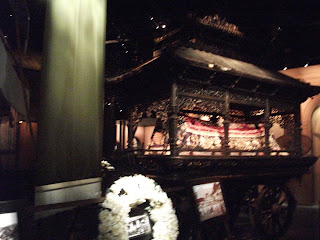
I know this is not relevant to World War II but I really find this quite fascinating though my hairs did stand with all the music playing on in the background and of course the dark setting of the museum. Scary much, but I like! HAHAHA.
Adawiyah Reflections : Changi Museum and Chapel
So I shall start my reflection proper. The previous post basically shows some of the pictures we took though I have to admit it is not a lot. And some of those taken were quite dark and blurry too so the ones that were posted were actually some of the best we've got, sadly. :(
That said, visiting the Changi Museum and Chapel can be described as a rather pleasant experience. The learning journeys that I had in my secondary(or primary? whichever it is) did not count since I really cannot recall much as I mentioned in the previous post.
When I entered the museum and chapel, I find the atmosphere rather gloomy and sombre. This is unsurprising of course since the museum and chapel were dedicated to all those who perished as well as those who suffered greatly under the Japanese hands during the dark years of World War II.
Indeed, as I walk around the museum, I uncover about the realities of the sufferings in more detail. How the POWs were tortured, starved and sent to do the Death Railway. How the Chinese people were massacred. The conditions of the prison cell. The types of tortures used against the Jap's enemies. The soldiers of all races, religions and nationalities who died and many more.
However, it seems interesting to note that despite all the sufferings and harsh treatments, there were instances whereby these soldiers portrayed great courage and attitude. The Australian soldiers for instance were best known for their comradeship. Indeed, despite the circumstances then, these soldiers would still do anything for their fellow brothers who are in need. Such displays of humanity seems to have strung my heartstrings greatly. Really, I'm not lying! Here we are complaining about every minor details when these soldiers were upholding a positive outlook despite being away from their homeland and families.
Of course, this is slightly different from what I have learnt in lecture. The museum seems to elevate the services of the foreign soldiers greatly whereas the lecture seems to mention about the foreign soldiers having some sort of a 'heck-care' attitude. After all, these soldiers were not fighting for their homeland or people and having such an attitude did not came as a surprise.
With that, I sort of felt that this museum were catered largely for the tourists who may have visit the place to pay their respects for the dead, even their family members who may have lost their lives. It seems a bit too 'propaganda-ish' for me as well since after all, schools will bring their students for such learning journeys and thus there is a need for them to put everything in an almost perfect, positive light.
That said, visiting the Changi Museum and Chapel can be described as a rather pleasant experience. The learning journeys that I had in my secondary(or primary? whichever it is) did not count since I really cannot recall much as I mentioned in the previous post.
When I entered the museum and chapel, I find the atmosphere rather gloomy and sombre. This is unsurprising of course since the museum and chapel were dedicated to all those who perished as well as those who suffered greatly under the Japanese hands during the dark years of World War II.
Indeed, as I walk around the museum, I uncover about the realities of the sufferings in more detail. How the POWs were tortured, starved and sent to do the Death Railway. How the Chinese people were massacred. The conditions of the prison cell. The types of tortures used against the Jap's enemies. The soldiers of all races, religions and nationalities who died and many more.
However, it seems interesting to note that despite all the sufferings and harsh treatments, there were instances whereby these soldiers portrayed great courage and attitude. The Australian soldiers for instance were best known for their comradeship. Indeed, despite the circumstances then, these soldiers would still do anything for their fellow brothers who are in need. Such displays of humanity seems to have strung my heartstrings greatly. Really, I'm not lying! Here we are complaining about every minor details when these soldiers were upholding a positive outlook despite being away from their homeland and families.
Of course, this is slightly different from what I have learnt in lecture. The museum seems to elevate the services of the foreign soldiers greatly whereas the lecture seems to mention about the foreign soldiers having some sort of a 'heck-care' attitude. After all, these soldiers were not fighting for their homeland or people and having such an attitude did not came as a surprise.
With that, I sort of felt that this museum were catered largely for the tourists who may have visit the place to pay their respects for the dead, even their family members who may have lost their lives. It seems a bit too 'propaganda-ish' for me as well since after all, schools will bring their students for such learning journeys and thus there is a need for them to put everything in an almost perfect, positive light.
Subscribe to:
Posts (Atom)